
|



 |
Note: Today’s post is Part 3 of The Shrinking Economic Weight of Energy — You can find Part 1 here and Part 2 here. It is also my most recent column for The Dispatch. At the bottom of this post ,THB paid subscribers can find Excel files for all data, figures, and analyses across the three-part series.
Comments invited!
At a moment of heightened polarization on nearly every issue facing the nation, it’s no wonder that energy consumption and climate change have become a political football for U.S. lawmakers left and right. But are Americans really as divided on these key public policy problems as they appear at first glance? A simple principle may offer us an answer.
The iron law of climate policy holds that when politicians force a choice between economic growth and emissions reductions, economic growth wins. Not because politicians are cynical or voters don’t care about the environment—most do—but because energy is foundational to everything else: to jobs, to heating and cooling homes, to food, to medicine, to the entire material standard of living. The iron law is every bit as real as the physics of energy and climate.
That reality shows up clearly in public opinion data. Just before the 2024 election, my American Enterprise Institute colleague Ruy Teixeira and I conducted a survey of what Americans think about energy and climate, a YouGov poll of more than 3,000 registered voters.
One result stood out above all others: An “all-of-the-above” approach to energy policy—one that includes oil, gas, solar, wind, and nuclear—commands majority support across every demographic and political group that we measured. It is the only question in the entire survey where we saw that degree of agreement, a rarity given today’s polarization on just about everything.
The survey also reveals that voters are ruthlessly pragmatic about energy costs. Asked whether they would support a $1 monthly fee on their electricity bill to fight climate change, only 47 percent of respondents said yes and 43 percent said no. Raise the fee to $20 and support collapses to 26 percent. At $100, the ratio is 7-to-1 against. Working-class voters are even more resistant to such fees at every level. Voters also ranked “dealing with global climate change” 15th out of 18 policy priorities—well behind keeping energy costs low, fighting inflation, and strengthening the economy.
The survey’s deeper message: Voters want lower prices and secure supply, and they want them across all energy sources. They generally support action on climate change, but only after these priorities are met. And while the U.S. energy supply and demand landscape is varied, there are issues on which almost all Americans agree. Politicians of both parties should take note.
To navigate the politics of energy, it is helpful to understand the notion of energy intensity: How much energy does an economy consume per dollar of output? If the economy grows faster than energy use, intensity falls. If energy use grows faster, intensity rises. The Kaya identity—the standard framework in climate policy for decomposing carbon emissions—treats energy intensity as one of four levers of decarbonization, alongside population, per-capita GDP, and the carbon intensity of energy supply.
There are two ways to measure intensity. Physical intensity tracks how much raw energy—barrels of gasoline, kilowatt-hours of electricity, tons of coal—flows through the economy per dollar of real output. Expenditure intensity tracks how much money Americans spend on energy as a share of GDP. Physical intensity tells you about efficiency and economic structure. Expenditure intensity tells you about the economic burden—which, as the iron law explains, is what drives the politics.
In two recent analyses for The Honest Broker on Substack, I looked at energy intensity across eight fuel and generation sources—gasoline, natural gas, coal, retail electricity, nuclear, hydro, wind, and solar—from 1970 to 2024. During this period, real U.S. GDP grew 341 percent while total primary energy consumption grew 39 percent, meaning that the economy grew roughly nine times faster than energy use. These technical details help us to better understand the bigger picture of the politics of energy in America.
A key reason for the gap between economic growth and increasing energy consumption was the oil shocks of 1973 and 1979, which led to a period of prolonged high energy prices that touched the entire economy. That signal drove policy-motivated and other efficiency investments in vehicles, buildings, and industrial processes that compounded for decades. At the same time, the composition of American output shifted toward less energy-intensive activities. Services, software, finance, and health care now occupy a larger share of GDP than they did 50 years ago, and they run on far less energy per dollar than the manufacturing and heavy industry they partially displaced.
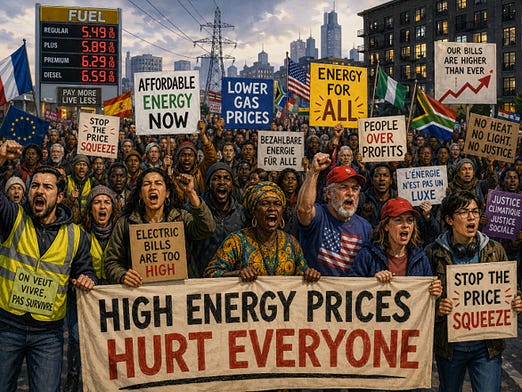
Policies that work with that prevailing dynamic, accelerating efficiency and innovation while keeping energy affordable, enjoy broad support. Policies that make energy more expensive, either as an unintended consequence or intentionally to coerce changes in supply or demand, tend to generate a political backlash—such as the backlash we see today in widespread public concern about affordability and inflation.
To better understand the political geography of energy, I compiled state-level data on electricity consumption, motor gasoline consumption, gasoline prices, population, and real GDP in 2023. These data tell two interesting stories.
Electricity intensity differs in red vs. blue states
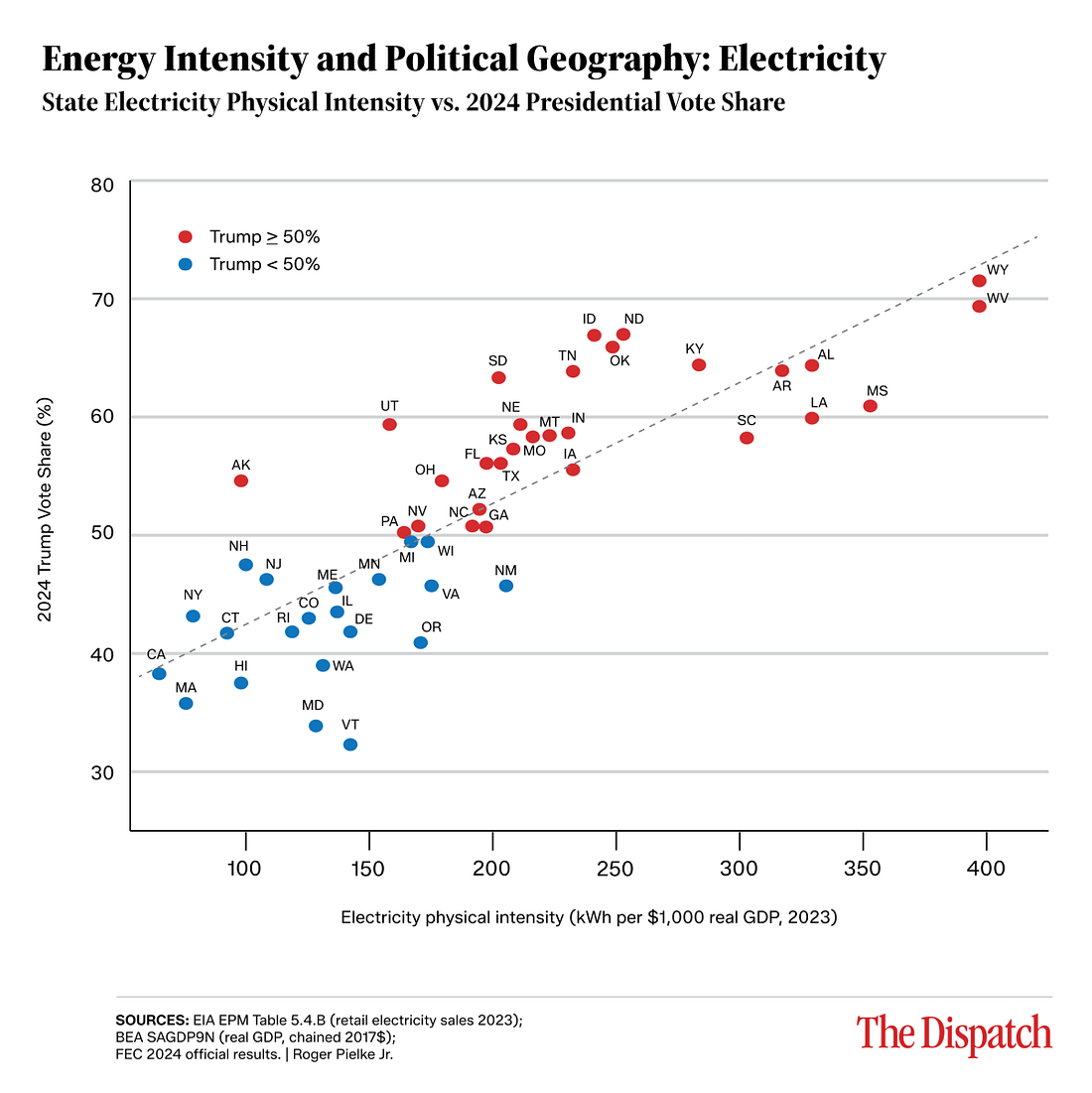
As the graph below shows, there is a strong correlation between a state’s electricity consumption per $1,000 GDP and its Trump vote share in the 2024 election. Republican-leaning states include the major energy producers—such as Texas, Wyoming, West Virginia, and North Dakota—and states with large industrial and agricultural economies. For instance, Wyoming’s physical electricity intensity is roughly six times that of California. Energy-intensive activities cluster in red states, while services and knowledge industries cluster more in blue states.
 |
But gasoline expenditure is a bipartisan story
When we shift from physical electricity intensity to what consumers actually spend on gasoline, the correlation nearly disappears. Interestingly, consumers in high-consumption red states and low-consumption blue states end up spending similar amounts on gasoline, due to differences in gasoline prices. Red states consume more gallons per capita but pay less at the pump—due to lower state taxes, shorter supply chains, and the absence of California-style fuel blend requirements. Blue states consume less but pay more per gallon.
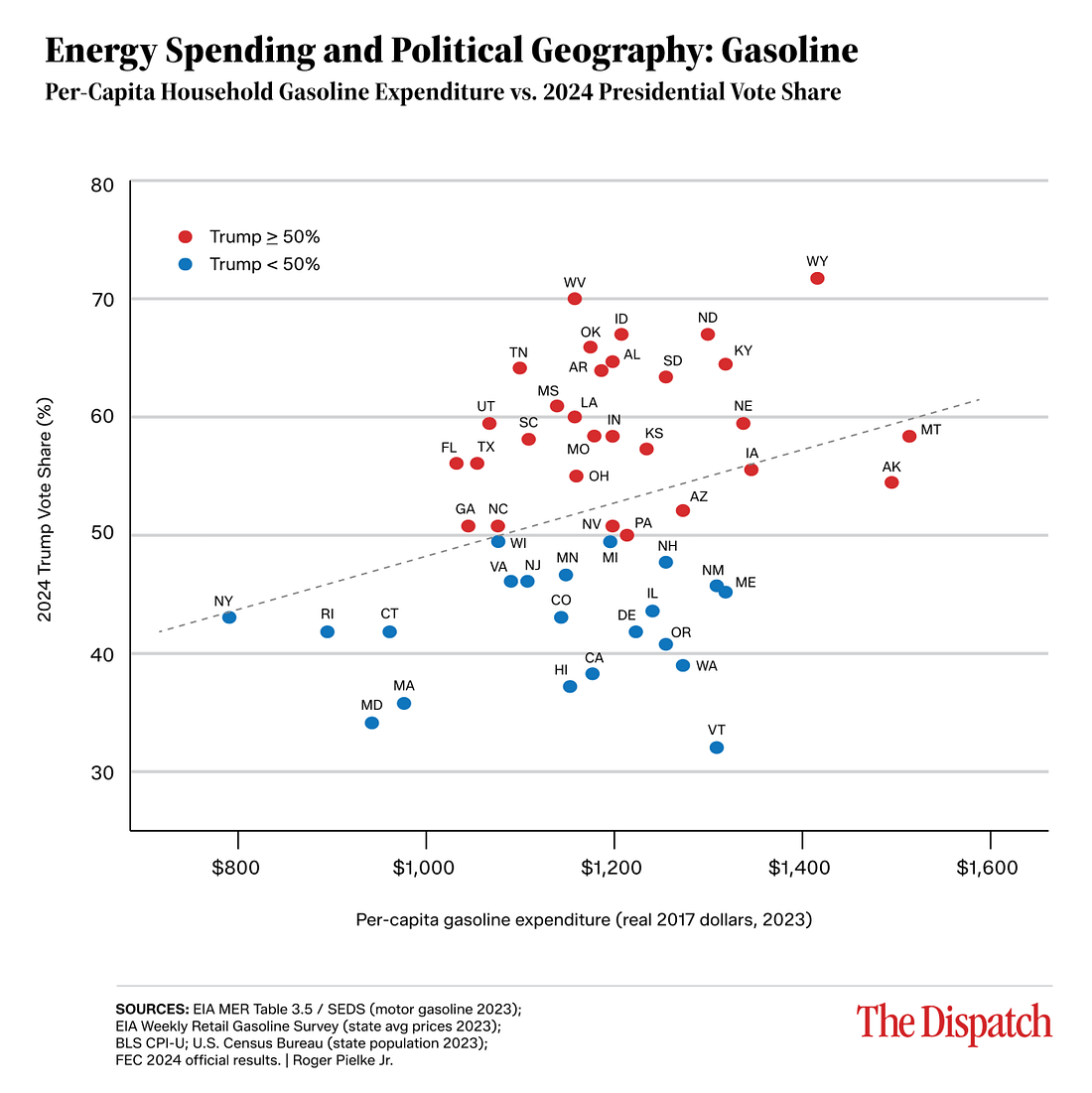 |
In practice, the fact that everyone feels the squeeze of higher gasoline prices means politicians from both parties will face backlash, and that backlash falls disproportionately on whoever is in power, regardless of the underlying causes. The iron law does not discriminate.
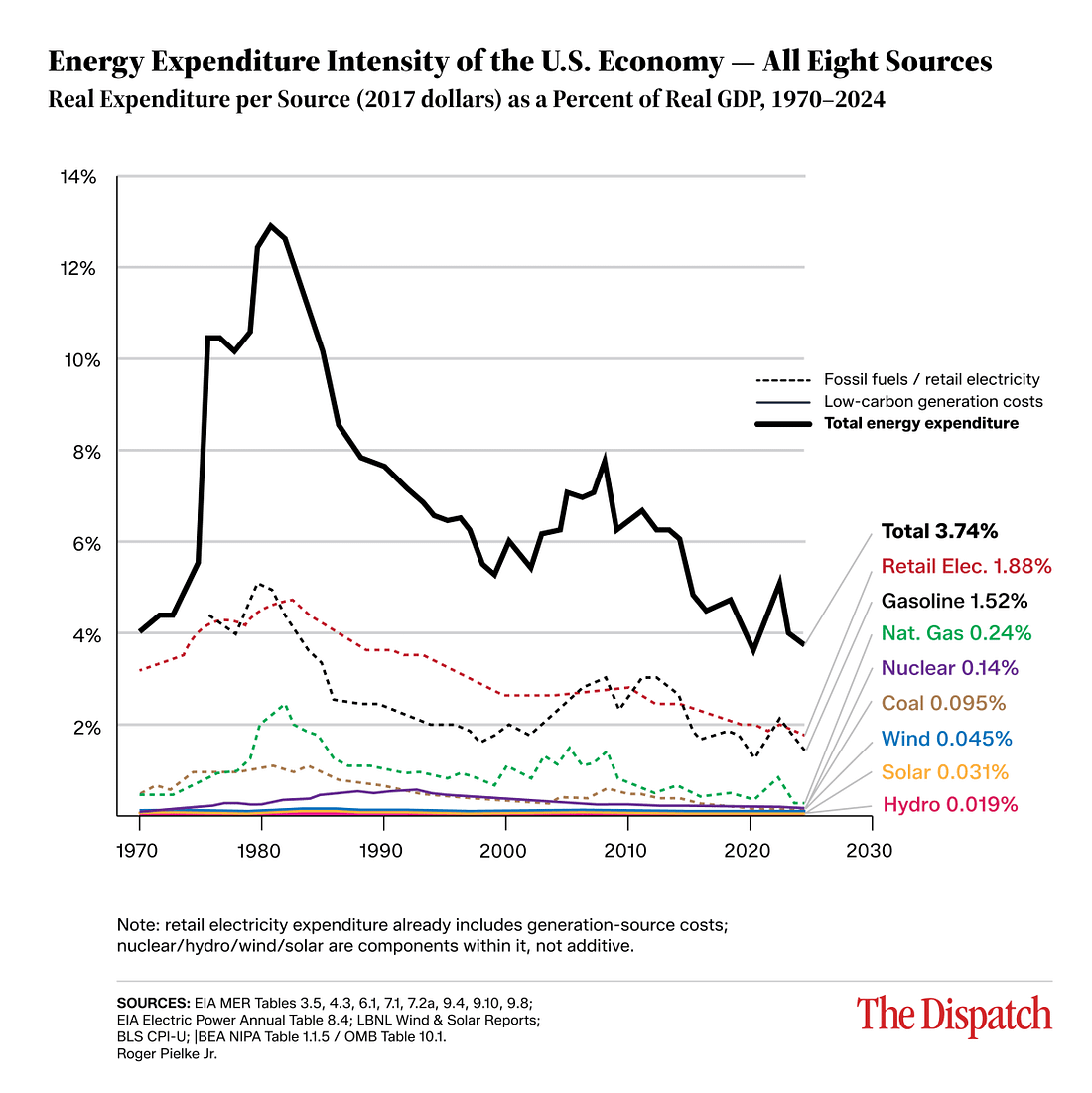
American spending on gasoline, natural gas, coal, and retail electricity together totaled roughly 3.8 percent of the real GDP in 2024. At its peak in the early 1980s, direct expenditures on those fuel sources represented more than 12 percent of national GDP, which helps to explain why the energy shocks of the 1970s continue to reverberate through the U.S. energy economy 50 years later.
At the same time, the United States devotes a smaller fraction of national income to direct energy expenditures today than at any point in the past half-century. But it is the relative change in that burden that matters most in today’s politics—not the historical context. A move from 3.8 percent to 5 percent of GDP would be politically significant even if 5 percent remains historically low. It is not the absolute level of the energy burden that drives political behavior, but the direction of change and who bears its cost. Lower prices and security of supply are shared priorities across the partisan divide.
 |
Support for an all-of-the-above approach—which prioritizes both affordability and diversity of supply—is the only unanimous majority position across every demographic and political group in our survey. This preference reflects voters’ shared direct experience of energy as a foundational economic good. Fossil fuels, wind turbines, and solar panels are often held up as political symbols by one side or the other, but when prices go up, posturing and symbolism are quickly shed in favor of realism and pragmatism.
Whether they vote Republican or Democrat, Americans want the lights to stay on and transportation to be affordable, regardless of what source or technology is providing that energy. The partisan divide in energy—as sharp as it may look among politicians and pundits—is far narrower at the level of normal Americans, wherever they live and whomever they vote for.
Evidence shows that the U.S. economy has been decarbonizing, steadily, for half a century. The mechanisms that drove that decarbonization are efficiency compounding through market signals, structural economic change, and targeted technological innovation driven by private and public sectors working together. If decarbonization of the economy is to continue in an era of growing energy demand—which it should, because it helps to drive the economic growth that benefits citizens and consumers—then these mechanisms will need to be sustained through conscious, collaborative effort.
The iron law is not an obstacle to effective energy or climate policies. Instead, it offers a boundary condition for policy design—everything starts with affordable, reliable, abundant energy—to achieve goals that a strong majority of Americans, across party lines, already support. An all-of-the-above strategy that keeps energy cheap and secure, while steadily improving the efficiency and carbon intensity of the supply, is not an obstacle to the decarbonization agenda. It is the precondition for it.
Policy Watch
A new survey of more than 3,500 U.S. political elites—including elected officials, staffers, regulators, lobbyists, and journalists—found that fewer than half of Republican respondents affirmed that global warming is primarily human-caused, with nearly one-third deeming a climate conspiracy claim—that “global warming is based on manipulated data to suppress dissent and undermine the economic dominance of the United States”—as more likely true than not. Democratic elites are near-unanimous in believing that warming is happening and due to human activities. Partisan identity explains more than 15 times as much variation in elite climate beliefs as general trust in scientists—more than ideology, conspiratorial disposition, education, or professional background. Efforts to use science to confront elites who dismiss anthropogenic climate change does not address the mechanism driving their dismissal—polarization, not data.
Tatsuya Terazawa, the chairman of the Institute of Energy Economics, Japan, recently published the clearest analysis available of what the current Iran crisis looks like from Tokyo. Japan imports nearly all of its oil and liquefied natural gas, making it highly dependent on Middle East exporters. But it also took steps to mitigate the current shortages, as Terazawa explains: “Japan had amassed 254 days’ worth of reserves, including five months’ worth as SPR managed by the Government, by the time of the attack on Iran on February 28. The high level of reserves has been one of the major pillars of energy security policies in Japan.” But Japan has more work to do to shore up its energy security, he argues. “After the resolution of the conflict, we should not forget the vulnerabilities of our energy system that have been painfully exposed.”
Innovation Spotlight
In a new report for the American Enterprise Institute, David Hart critiqued Vannevar Bush’s 1945 metaphor of an “endless frontier” for future scientific progress, an idea that has long shaped U.S. policy. When it comes to energy technology today, Hart concludes, the frontier is no longer open. Chinese advancements—in fields ranging from polysilicon and solar modules to battery chemistry and EV supply chains—have already settled much of it. American innovators contesting that terrain are not pioneers in open country; they are operating in a zone of conflict against entrenched incumbents with substantial first-mover advantages. The policy implication: The standard toolkit of basic research funding and startup support is insufficient for this environment. Hart advocates for a systematic deployment of fiscal, regulatory, informational, and diplomatic tools—but focused narrowly on a few high-priority domains where the U.S. has a genuine comparative advantage rather than attempting broad leadership across the energy technology landscape. Scope, he argues, is a strategic asset when institutional capacity is limited and political coalitions are fragile.
Further Reading
Reuters energy columnist John Kemp just released his recommended reading for 2026. The bibliography covers production, consumption, transportation, technology, trading, economic history, and geography—and his criterion for inclusion is straightforward: He has read it and found it useful.
Comments welcome!
Note: The annual subscription for THB increases to $100 on June 1. Lock in your support at a lower level!
Before you go: Please click that “❤️ Like” button. More likes means more readers of THB. Thanks!...
Keep reading with a 7-day free trial
Subscribe to The Honest Broker to keep reading this post and get 7 days of free access to the full post archives.
A subscription gets you:
| Support of independent research and analyses where science and politics collide | |
| Post comments and secure all-access | |
| Email me directly, access paywalled PDFs of my books and peer-reviewed research |
| ||||||||||


