|
 |




So we’ve already covered the awkward fact that Covid rates were falling before lockdown came into force. The curve had begun to bend before ministers reached for the emergency brake. That alone should have triggered a more cautious interpretation of what followed.
Lockdowns: A Matter of Timing? | ||||||
| ||||||
 | ||||||
Restrictions, lockdowns, travel bans, tiers, curfews — in 2020, they changed so frequently that even the most diligent observer struggled to keep up. | ||||||
|
Yet for years, to even raise the timing issue was to invite accusations of heresy. Lockdowns were presented not merely as policy choices, but as moral imperatives. Questioning their effectiveness was treated as recklessness, or worse. Only now are some people discovering, or perhaps daring to admit, that the evidence does not sit comfortably with the official narrative.
A new analysis in the Journal of the Royal Statistical Society, reported by Sarah Knapton in the Telegraph, raises concerns about lockdowns. Researchers found that in 15 of 17 examined lockdowns across ten European countries, infection peaks occurred before the restrictions were imposed, including all three in England.
In other words, the virus appears to have turned before the law did, raising an inconvenient truth: that governments claimed credit for trends already in motion.
For some, this is new information. For others, it is confirmation of doubts long held but rarely voiced. What is striking is not that data continue to evolve, that is normal, but that it has taken this long for timing itself to become part of mainstream discussion. After all, in epidemic response, timing is everything. And if the peak comes before the policy, the story we tell about cause and effect deserves another look.
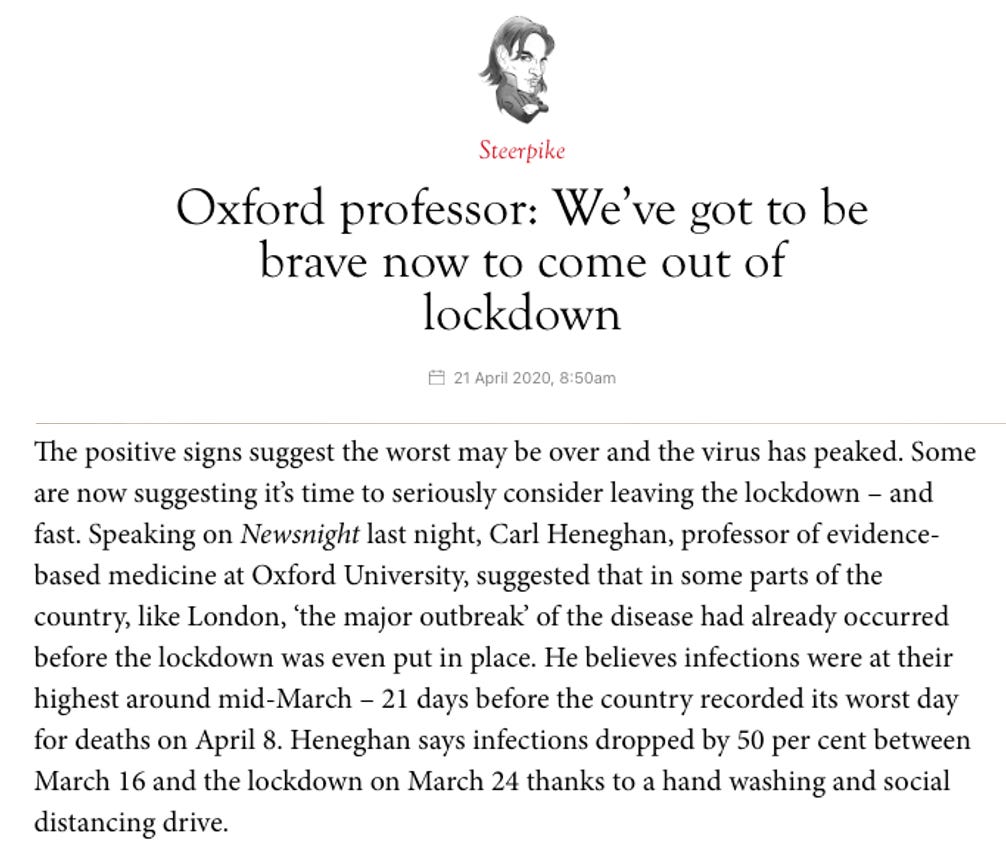 |
In mid-April 2020, multiple media outlets reported Carl’s observation that the highest number of COVID-19 deaths in the UK occurred on April 8, 2020 (see here, here, and here). LINKS/
Working backwards using the typical delay from infection to death (about three weeks), infections must have peaked around mid-March, before the 23 March lockdown.
It is one of the quieter curiosities of 2020 that we suddenly forgot how to count. For decades,s we had insisted on evidence-based medicine. Randomisation, control groups and adjustment for confounding. Then, at the first whiff of exponential curves and Imperial slides, we quietly placed those principles in a drawer labelled “not for use during emergencies.”
Why did so few analyse the timing data? The numbers were publicly available, as were death registrations and surveillance curves. You did not need a supercomputer — only the willingness to ask whether the peak preceded the policy.
But incentives matter. In a crisis, caution is not rewarded; conformity is. To question the timing of lockdowns was to risk being cast as indifferent to death. Academics went silent, and journals became overly cautious. The media preferred models with apocalyptic y-axes, and social media, with overnight experts, handled the rest.
And so evidence-based medicine became policy-based evidence: We justified first and asked questions later.
Now, safely distant from daily press conferences and emergency powers, retrospective courage is easier to muster. Statistical reconstructions appear in respectable journals. And the headlines cautiously note what some said in April 2020.
Of course, it is late. The schools closed, the cancers undiagnosed, and the debts accumulated. But as the epidemics passed, institutional memory lingers.
The real question is not why people speak now. It is why so few felt able to speak then.
This post was written by an old geezer who spoke and faced the consequences.
You're currently a free subscriber to Trust the Evidence. For the full experience, upgrade your subscription.
| ||||||||||

