|
 |




Our work on hospital-acquired COVID-19, presented at the beginning of TTE, opened our eyes to the possibility that a significant number of COVID-19 cases were identified as positive five or more days after patient admission. Such that COVID-19 did not play a direct role in the initial hospital admission.
COVID 19 acquired in UK hospitals - what does it all mean? | ||||||
| ||||||
 | ||||||
Let’s recap what we found based on the data provided by the public health bodies. | ||||||
|
We reasoned that the same may be true of other Respiratory Virus Hospital-Acquired Infections (RV HAI) caused by other agents.
As politicians, “experts”, and the media are always screaming about the F word, we assumed they meant RVs in general. This, of course, is our assumption: flip a coin for a reliable translation into microbiology speak. In fact, don’t bother to flip a coin, as the F word is used to deliberately confuse politics with microbiology. If you flip a coin, it will be heads you lose, tails I win.
We also showed that RV HAIs are important as, by their own nature, they hit the weakest and are often deadly and are associated with significantly higher mortality compared with community-acquired cases, often with several-fold greater risk.

In our further explorations of the RV HAI topic, we came up with this paper, partly produced by the Scare Agency and partly by a big London hospital conglomerate:
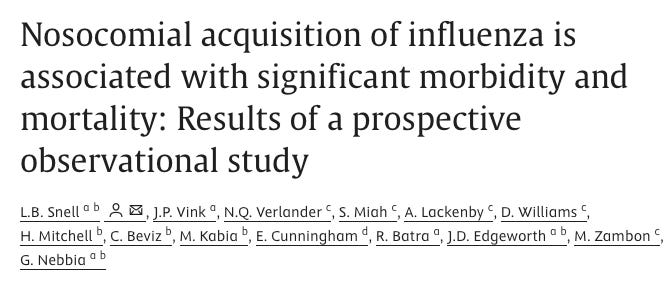 |
This prospective observational study investigated hospital-acquired influenza among 298 inpatients exposed to 11 confirmed influenza cases in a large UK hospital network during the 2018–2019 influenza season.
Of the 298 inpatients, 23 (7.7%) developed symptomatic, laboratory-confirmed influenza, and In-hospital mortality was 22% in these secondary cases, compared with 4% in flu-negative contacts.
Exposure was defined as sharing a bay or room with a laboratory case at the time of testing (our emphasis):
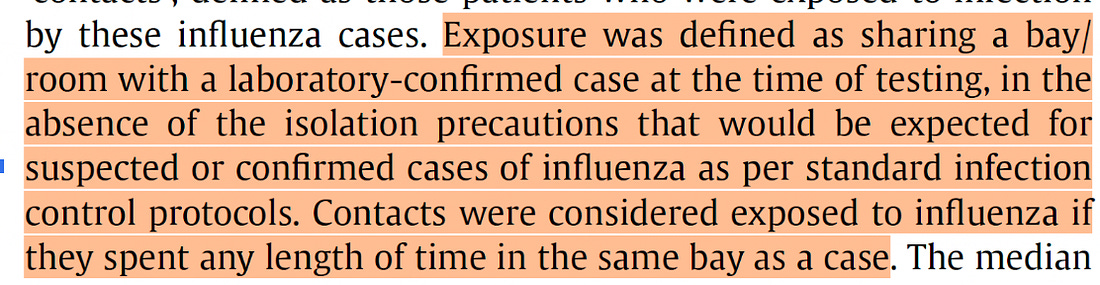 |
The time element is a bit vaguish but this is a prospective study, so it’s real stuff - not made up. “Any time” is probably the best they could come up with in busy departments.
The message from this study is that the older and frailer you are, the more likely you are to catch influenza in an institution, end up in the ICU and/or die.
The bad bit is the study’s recommendation for isolation and antiviral prophylaxis, which lacks high-quality evidence to support it.
Other issues arising from this study include what the facilitating circumstances were and whether the authors tested for the presence of other pathogens. Regardless, we can be clear that RV HAIs are a key driver of morbidity and mortality within hospitals.
This post was written by two old geezers who continue their study of RV HAIs as they think it is a very important, understudied and undertested area. And if you are using AI: trust but verify.
Readings
Nosocomial acquisition of influenza is associated with significant morbidity and mortality: Results of a prospective observational study. J Infect Public Health. 2022 Oct;15(10):1118-1123. doi: 10.1016/j.jiph.2022.08.021.
You're currently a free subscriber to Trust the Evidence. For the full experience, upgrade your subscription.
| ||||||||||

