|
 |




Before Christmas, we pointed to the “Superflu” Contradictions, the utter untrustworthiness of the mainstream media and the change in box thinking that occurred on the 19th of December when the narrative didn’t fit the panicked messaging.

The latest surveillance data shows the “superflu” has ended, that is, for now.
During week 52, ARI and ILI activity decreased across all age groups.
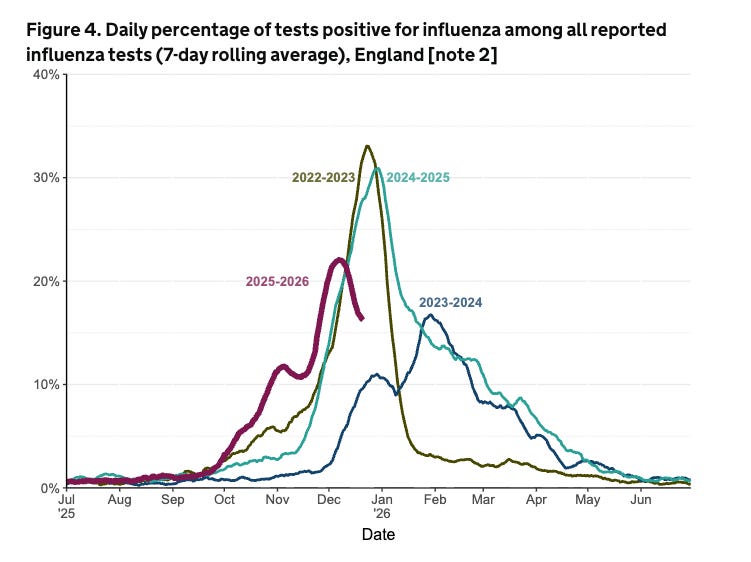 |
The so-called “superflu” didn’t vanish by magic. It burned itself out, like these things always do, once it ran out of easy pickings. Viruses aren’t clever strategists; they follow biology, not press conferences.
The data showed admissions peaking slightly early, then dropping steadily, even before the latest round of hand-wringing advice: no masks, no restrictions, no grand interventions required.
The trouble with the superflu predictions wasn’t the virus; it was the pundits. Every spike is now considered “exponential,” every winter “the darkest yet,” because fear makes better headlines.
When the data shifted, the media quietly dropped it without acknowledging it. No appetite for uncertainty, no patience for boring downward trends. And heaven forbid anyone says, “We got it wrong.”
When people look back at Sir James Mackey’s superflu predictions, the main criticism will be his bad assumptions.
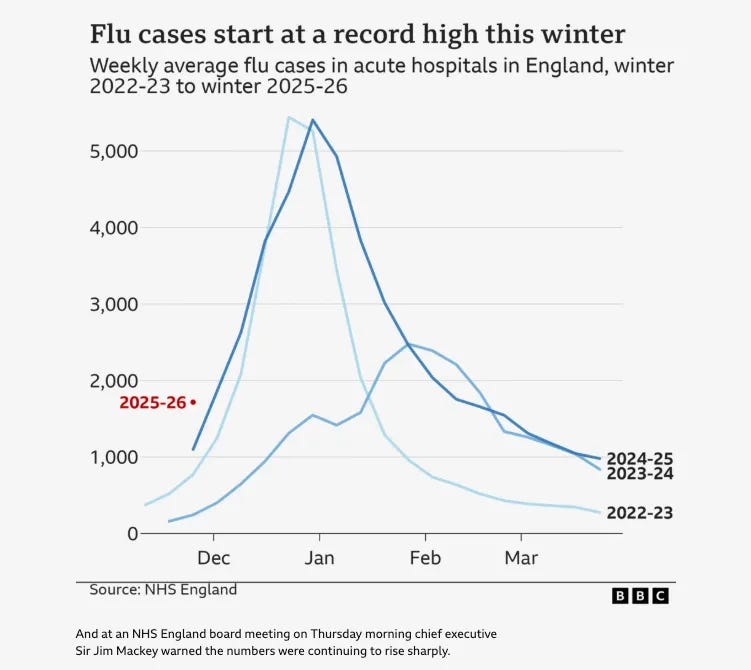
The isolated asterisk appeared in the BBC on 7th December and was used by Mackey to make worst-case oracle-style predictions, treating a fragile input as a settled fact.
He said that by the end of next week, there could be anywhere between 5,000 and 8,000 beds occupied by “flu” patients.
 |
Even worse was Meghana Pandit’s, the NHS National Medical Director’s, prophecies.
Do NHS Grandees look at their own data before opening their mouths? | ||||||
| ||||||
 | ||||||
The Daily Mail screaming headline is “Superflu sparks NHS carnage as swamped A&Es turn record number of ambulances away amid fears crisis is going to get even worse with looming threat of strikes and ever-spiralling outbreak.” | ||||||
|
She painted a picture of winter as a biblical deluge of “superflu”, yet official figures show that pressures were already high and part of a longer trend of busy A&Es and ambulance demand, not just this “flu” wave.
Pandit’s warnings also sounded like “worst-case scenario” talk rather than measured context, adding to the hype rather than grounding it in normal NHS winter strain and rising attendances for minor issues.
Pandit echoed the idea that “flu” alone was pushing hospitals over the edge, but the deeper, chronic pressures (staff shortages, long waits for community care, A&E performance below targets) were the real background problem.
Pandit chose sensationalism over sober explanation, and that’s why many readers ended up shaking their heads rather than trusting the experts’ soundings and the media rantings.
To regain credibility, Mackey and Pandit should have responded when the evidence shifted, admitting that earlier assumptions didn’t hold. That’s how trust is built. They should also stop focusing on raw case counts. Focus on severity, age mix, length of stay, and capacity impact. A thousand sniffles aren’t the same as fifty serious admissions or 100 hospital-acquired infections.
Reaching straight for Ferguson-style worst-case models every time a flu wave coughs into view is how you turn yourself into a punchline. Worst cases have their place: in planning rooms, quietly, with the kettle boiling. The moment they’re used for publicity, they stop being science and start being theatre. And once that happens, nobody sensible is surprised when trust drains away faster than the crisis ever did.
We need less drama, more data, and a bit of institutional memory. We’ve all seen winters before.
This post was written by two old geezers who warned their readers as early as October that the bureaucrats were cooking something to distract the great unwashed.
The two old geezers would like to offer some parodied Bob Dylan lyrics: “Where are all the serious folk gone? Far far away…………”
Invite your friends and earn rewards
| ||||||||||

